 Skip to main content

Antitrust M&A Outlook for 2026
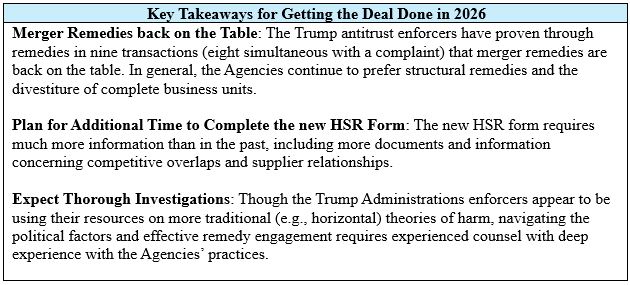
The Trump Administration’s Federal Trade Commission (FTC) and Justice Department Antitrust Division (DOJ) are likely to continue their trend of accepting remedies to resolve mergers that present anticompetitive concerns, while at the same time, litigating mergers that cannot be thoroughly resolved via remedies and where the Agencies believe they can win in court.
The willingness to engage on and accept merger remedies is a welcome development. The Biden DOJ resolved only one merger investigation via consent, after seven months of litigation.[1] The Biden FTC’s last consent decree for a pre-litigation divestiture remedy of tangible assets was in October of 2022.[2]
However, the Trump Administration did not stop the Biden Administration’s revised HSR Rule from becoming effective in February 2025. The new merger reporting form has substantially increased the costs and burden on filing parties, even on transactions that have no colorable competition problem.
After a multi-year suspension of early termination under the HSR Act by the Biden FTC, the Trump enforcers began issuing early termination again. With an interruption for the government shutdown in the fall of 2025, the Agencies have been slowly increasing the frequency with which they grant early termination—for example, in the first 12 days of December, the FTC granted early termination 48 times.
Notable Trends in 2025
Horizontal Challenges. Every litigated merger challenge since inauguration has been based upon horizontal theories of harm. Only one challenge (filed simultaneously with a consent decree) was based upon a vertical theory of harm (Boeing/Spirit). It bears noting, however, that the Trump Administration has not indicated it intends to depart from the 2023 Merger Guidelines’ analytical approach to assessing non-horizontal mergers.
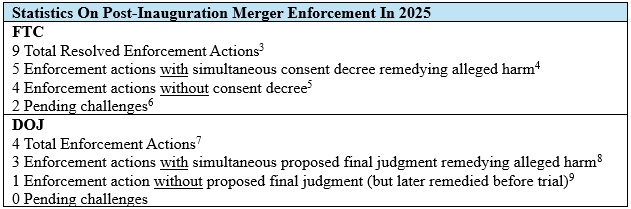
The Agencies appear to be thoroughly investigating mergers. While numbers don’t tell the whole story, the FTC under Trump in 2025 has challenged nine mergers, compared to five merger enforcement actions in the final year of the Biden administration.[10] Though the Trump DOJ has lagged in the number of enforcement actions compared to the FTC, it challenged four transactions in 2025, three more than in the final year of the Biden Administration.[11]
Two FTC challenges were litigated to resolution, with the FTC winning one and losing the other. In the first, GTCR/Surmodics, the FTC alleged that the proposed merger would violate section 7 of the Clayton Act in the market for outsourced hydrophilic coatings.[12] The court denied the FTC’s request to preliminarily enjoin the transaction, crediting the ability for the buyers to self supply as a competitive constraint on the market. The FTC prevailed in the second challenge, Edwards/Jenavalve. In that case, Edwards sought to acquire the only two companies with products in the development pipeline. The merging parties were each still “developing” the overlapping product,[13] meaning that neither were in the market competing for sales. However, the court determined that “the Proposed Transaction would grant Edwards a total monopoly in the [relevant] market market because at least one of [the products]—or both—will likely obtain FDA approval at least several years before another [competing product] manages to do so.”[14] The parties abandoned the transaction after the district court’s decision.
Sometimes, much about merger enforcement can be learned by the mergers that the agencies allow to close without a remedy or enforcement action. T-Mobile’s acquisition of UScellular provides one such example. AAG Gail Slater issued a closing statement that began by describing concerns with consolidation in the mobile wireless services and noting the potential competitive importance of smaller disrupters such as UScellular. DOJ ultimately concluded, however, that UScellular lacked the scale to be a real competitive constraint and that T-Mobile’s scale would benefit consumers. As a takeaway for dealmakers, it appears that AAG Slater is willing to credit consumer benefits and efficiencies in the face of horizontal consolidation that may otherwise result in anticompetitive effects.
Divestiture Merger Remedies
Early in the Administration, agency leadership expressed a willingness to consider and accept robust divestiture remedies,[15] and they have followed through on their expressions. The DOJ has resolved three merger investigations via a divestiture remedy: Keysight/Spirent,[16] Safran/RTX,[17] Constellation/Calpine.[18] DOJ has also settled two ongoing merger litigations via divestitures: Hewlett Packard/Juniper[19] and UnitedHealth/Amedysis (which was filed during the Biden Administration).[20] The FTC resolved four merger investigations via a divestiture remedy: Synopsys/Ansys, ACT/Giant Eagle, Valvoline/GreenBriar, and Boeing/Spirit. The agencies also resolved two additional investigations in January of 2026: Reddy Ice/Arctic Glacier and Sevita/BrightSpring.
With a few exceptions discussed below, these remedies represent fairly standard divestitures. Through speeches and statements, agency officials seem to have coalesced around four principles that are roughly consistent with longstanding concerns about the adequacy of divestitures: (1) structural remedies are preferred, (2) the divested assets should be a complete business unit (or as close to it as possible), (3) the divestiture buyer should be identified upfront and be ready to compete, and (4) ongoing entanglements should be minimal.[21]
As for “litigating the fix,” GTCR/Surmodics is yet another example[22] of a court holding that a proposed remedy need only prevent a substantial lessening of competition, rather than replace all lost competition.[23] Coming out of that case, Chairman Ferguson has expressed a desire for merging parties to offer remedies early in the process rather than on the eve of trial.[24] It is possible that the current Administration will be more open to negotiating acceptable remedies, while the parties retain the option of “litigating the fix.”
Innovative Merger Remedies
Some of the remedies pursued by the Trump Administration antitrust Agencies represent more novel approaches to resolving merger concerns. The DOJ’s challenge of Hewlett Packard’s acquisition of Juniper is most noteworthy. After much-reported involvement by senior officials at DOJ, the challenge was resolved via divestiture without an upfront buyer and with a novel software licensing requirement. It remains to be seen whether DOJ will be willing to resolve matters going forward without requiring an upfront buyer. With respect to licensing, the proposed final judgment (“PFJ”) requires Hewlett Packard to auction off perpetual worldwide licenses to the source code for Juniper’s AI Ops for Mist software. Through the auction required by the PFJ, it is possible that HPE could be required to grant licenses to multiple independent competitors.[25] (The settlement remains under Tunney Act review in the US District Court for the District of Columbia.)
The FTC did not require a structural remedy in Omnicom/IPG. Instead, it remedied the merger with behavioral provisions that prevent the merging parties from colluding “to direct advertising away from media publishers based on the publishers’ political or ideological viewpoints.”[26]
Finally of note, in the recent Reddy Ice/Arctic Glacier remedy, the PFJ requires prior notice and a 30-day waiting period on future acquisitions by Reddy Ice in the divestiture markets where the target “entity [is] valued at 15% of the HSR Act’s ‘size of transaction’ threshold (as adjusted annually) or greater.” The PFJ also requires prior notice for transactions within 50 miles of certain airports where the parties agreed to divest certain customer contracts.
Healthcare/Medical Device Focus
The FTC has been particularly active with mergers in the healthcare space. The only two litigated merger challenges of the year related to medical products. First, in GTCR/Surmodics, the products at issue were hydrophilic coatings applied to medical devices such as catheters, guidewires, and stents.[27] In Edwards/Jenavalve, the products at issue were “transcatheter aortic valve replacement device[s] for the treatment of aortic regurgitation.”[28] The proposed acquisition of Rotech by Owens & Minor—combining entities that deliver medical supplies and equipment to homes—was terminated when the “path to obtain regulatory clearance [before the FTC] proved unviable.”[29]
First Year of the new HSR Form and the return of Early Termination
The Biden Administration finalized the HSR rulemaking in September of 2024 and the new HSR form became effective on February 7, 2025. The new form increases the burden on filing parties: it requires more documents and information and requires more time to prepare the filings—raising costs even on transactions that have no colorable competition problem. Any hope that the new form would be withdrawn after inauguration was ended when Chairman Feguson made clear they are here to stay. As filers have learned this year, the new form imposes substantial burden, which comes with more costs and more delays. Chairman Ferguson has argued that the new HSR form is a “win-win” for the government and merging parties because the filings will allow the FTC to “more quickly determine which deals may pose competition concerns and which deals would not.”[30]
The extent of benefits depend at least in part upon reinstitution of early termination under the HSR Act. The Agencies stopped granting early termination in 2021, a supposed “temporary suspension” that remained in effect for the remainder of the Biden Administration. For context, under the first Trump Administration, the Agencies granted early termination, on average, nearly 1,100 times each year.[31] But once the Agencies suspended early termination,[32] they effectively granted zero early terminations for the rest of the Biden Administration.[33] Under the second Trump Administration, the Agencies granted early termination 381 times in 2025. Though this rate is not close to the same levels as the first Trump Administration, the trend seems to be increasing (absent the government shutdown), with the Agencies granting early termination 122 times in December alone.
States Ramping up Merger Enforcement
Both Colorado and Washington have enacted “mini” HSR Acts that require merging parties to submit their HSR filings to the state when certain thresholds relating to impact in the state are met. Other states are considering similar statutes. In the past, a variety of states have required merger notifications in specific industries (e.g., healthcare, retail), but the generally applicable statutes are a development that has a much broader effect. Dealmakers need to be aware of this trend and plan for the additional costs (and potential delays) that follow. Further, state enforcers have expressed a desire to ramp up merger enforcement and potentially bring merger enforcement actions alone, without the support of the federal agencies.[34]
Section 8 Enforcement—Interlocking Directorates
Both Agencies during the Biden Administration enforced Section 8 of the Clayton Act, which prohibits “[i]nterlocking directorates and officers.”[35] Under Section 8, directors and officers of corporations cannot simultaneously serve on two boards or within two competing companies.[36] No showing of effects is required.[37] Historically, Section 8 violations were discovered during merger investigations and existing or potential future violations were normally resolved by the firms voluntarily ending the interlock. But both Chair Khan and AAG Kanter sought to more aggressively identify and enforce against violations of Section 8, specifically involving private equity investments.[38] The FTC was particularly novel in its enforcement, in one matter enforcing Section 8 against non-corporate entities even though the text of the statute specifically states that the statute applies to corporations (Quantum/EQT).[39] Chair Khan asserted that the FTC’s action “makes clear that Section 8 applies to businesses even if they are structured as limited partnerships or limited liability corporations.”[40]
Thus far, the antitrust Agencies under the second Trump Administration have provided only two data points related to Section 8. First, in September of 2025, the FTC announced that three board members of Sevita Health had stepped down to avoid an unlawful board interlock.[41] In stark contrast to the Biden administration, the agency did not issue a complaint or consent decree. Second, in late-September 2025, the Commission issued an order denying the petition to reopen the FTC’s 2023 Decision and Order with Quantum/EQT. The most notable takeaway from the order is the fact that the Commission sidestepped the issue about whether a non-corporate entity could violate Section 8.[42] Thus, despite the limited activity under Section 8, the lack of clarity on the current Commission’s view on its applicability to non-corporate entities warrants some caution.
2026 Watchlist
As we launch into 2026, here are some of the “hot” antitrust issues to watch:
- The outcome of Trump v. Slaughter determining whether President Trump has the authority to remove FTC commissioners without cause.
- The outcome of the Tunney Act proceeding in Hewlett Packard/Juniper.
- Whether the agencies engage on revisions to the 2023 Merger Guidelines.
- Whether the agencies pursue aggressive non-horizontal merger enforcement.
- How the agencies respond to “Big Tech” mergers, including acquisitions of startups and in transforming industries like AI.
- Whether state enforcers ramp up merger enforcement, potentially even challenging mergers without the support of the federal agencies.
- The role of economics and data in the agencies’ merger investigations and litigation.
- The battle between Netflix and Paramount to acquire Warner Brothers and the resulting outcome of the DOJ’s investigation.
[1] Antitrust Division, U.S. Dept. of Just., U.S. v. ASSA ABLOY AB, and Spectrum Brand Holdings, Inc.,
https://www.justice.gov/atr/case/us-v-assa-abloy-et-al.
[2] This does not include Exxon/Pioneer, Chevron/Hess, or EQT/Quantum. See Comm’r Melissa Holyoak, Structural Merger Remedies, Keynote Address at the USC Gould/Analysis Group Global Competition Law Thought Leadership Conference Speech (Jun. 5, 2025), https://www.ftc.gov/system/files/ftc_gov/pdf/holyoak-keynote-usc-gould-leadership-conference.pdf.
[3] GTCR/Surmodics, https://www.ftc.gov/legal-library/browse/cases-proceedings/241-0095-gtcr-bc-holdings-llc-surmodics-inc-matter; Synopsys/Ansys, https://www.ftc.gov/legal-library/browse/cases-proceedings/241-0059-c-4820-synopsys-inc-ansys-inc-matter; Omnicom/Interpublic, https://www.ftc.gov/legal-library/browse/cases-proceedings/251-0049-omnicom-groupthe-interpublic-group-co; ACT/Giant Eagle, https://www.ftc.gov/legal-library/browse/cases-proceedings/241-0111-alimentation-couche-tardgiant-eagle; Edwards/JenaValve, https://www.ftc.gov/legal-library/browse/cases-proceedings/edwards-lifesciences-corp-jenavalve-technology-inc-matter; Zillow/Redfin, https://www.ftc.gov/legal-library/browse/cases-proceedings/zillow-groupredfin-corp; Valvoline/Greenbriar, https://www.ftc.gov/legal-library/browse/cases-proceedings/valvoline-incgreenbriar-equity-fund-v-lp; Boeing/Spirit, https://www.ftc.gov/legal-library/browse/cases-proceedings/241-0098-boeing-co-spirit-aerosystems-holdings; Henkel/A-Paint, https://www.ftc.gov/legal-library/browse/cases-proceedings/henkel-paint.
[4] Synopsys/Ansys; Omnicom/Interpublic; ACT/Giant Eagle; Valvoline/GreenBriar; Boeing/Spirit.
[5] GTCR/Surmodics; Edwards/JenaValve; Zillow/Redfin; Henkel/A-Paint.
[6] Zillow/Redfin; Henkel/A-Paint. The court granted the FTC’s request for preliminary injunction in Edwards/Jenavalve and denied the request for preliminary injunction in GTCR/Surmodics.
[7] HPE/Juniper, https://www.justice.gov/atr/case/us-v-hewlett-packard-enterprise-co-and-juniper-networks-inc; Keysight/Spirent, https://www.justice.gov/atr/case/us-v-keysight-technologies-inc-and-spirent-communications-plc; Constellation/Calpine, https://www.justice.gov/atr/case/us-and-plaintiff-states-v-constellation-energy-corporation-et-al; Safran/RTX, https://www.justice.gov/atr/case/us-v-sanfran-et-al.
[8] Keysight/Spirent, Constellation/Calpine, Safran/RTX.
[9] HPE/Juniper.
[10] Novant/CHS, https://www.ftc.gov/legal-library/browse/cases-proceedings/231-0068-novant-health-inc-community-health-systems-inc-matter; Kroger/Albertsons, https://www.ftc.gov/legal-library/browse/cases-proceedings/kroger-companyalbertsons-companies-inc-matter; Chevron/Hess, https://www.ftc.gov/legal-library/browse/cases-proceedings/241-0008-chevronhess-matter; Exxon/Pioneer, https://www.ftc.gov/legal-library/browse/cases-proceedings/241-0004-exxon-mobil-corporation-matter; Tempur Sealy/Mattress Firm, https://www.ftc.gov/legal-library/browse/cases-proceedings/231-0016-tempur-sealy-international-inc-mattress-firm-group-inc-matter.
[11] United Health/Amedisys, https://www.justice.gov/atr/case/us-and-plaintiff-states-v-unitedhealth-group-inc-and-amedisys-inc.
[12] GTCR/Surmodics Compl., ¶ 28, https://www.ftc.gov/system/files/ftc_gov/pdf/d9440_part_3_complaint_public_redacted.pdf.
[13] Edwards/Jenavalve Compl. ¶ 1, https://www.ftc.gov/system/files/ftc_gov/pdf/d9442_p3_complaint_public_redacted_0.pdf.
[14] Edwards/Jenavalve, Preliminary Injunction Op., https://business.cch.com/ald/FTCvEdwards176-1.pdf.
[15] Senate Confirmation Hearing, Gail Slater, Assistant Attorney General, U.S. Dept. of Just. (Feb. 12, 2025), https://www.judiciary.senate.gov/committee-activity/hearings/02/12/2025/nominations; Comm’r Melissa Holyoak, A New Season at the FTC, Remarks at GCR Live: Law Leaders Global 2025 (Jan. 30, 2025), https://www.ftc.gov/system/files/ftc_gov/pdf/2025-02-04-holyoak-remarksr-for-global-competition-review-event.pdf.
[16] Press Release, U.S. Dept. of Just., Justice Department Requires Keysight to Divest Assets to Proceed with Spirent Acquisition (Jun. 2, 2025), https://www.justice.gov/opa/pr/justice-department-requires-keysight-divest-assets-proceed-spirent-acquisition; DAAG Bill Rinner Delivers Remarks to the George Washington University Competition and Innovation Lab Conference Regarding Merger Review and Enforcement (Jun. 4, 2025), https://www.justice.gov/opa/speech/daag-bill-rinner-delivers-remarks-george-washington-university-competition-and.
[17] Press Release, U.S. Dept. of Just., Justice Department Requires Safran to Divest Assets to Proceed with Acquisition of Raytheon Assets (Jun. 17, 2025), https://www.justice.gov/opa/pr/justice-department-requires-safran-divest-assets-proceed-acquisition-raytheon-assets.
[18] Press Release, U.S. Dept. of Just., Justice Department Requires Divestitures to Proceed with Constellation’s Proposed $26.6 Billion Acquisition of Calpine (Dec. 5, 2025), https://www.justice.gov/opa/pr/justice-department-requires-divestitures-proceed-constellations-proposed-266-billion.
[19] Press Release, U.S. Dept. of Just., Justice Department Requires Divestitures and Licensing Commitments in HPE’s Acquisition of Juniper Networks (Jun. 28, 2025), https://www.justice.gov/opa/pr/justice-department-requires-divestitures-and-licensing-commitments-hpes-acquisition-juniper.
[20] Press Release, U.S. Dept. of Just., Justice Department Requires Broad Divestitures to Resolve Challenge to UnitedHealth’s Acquisition of Amedisys (Aug. 7, 2025), https://www.justice.gov/opa/pr/justice-department-requires-broad-divestitures-resolve-challenge-unitedhealths-acquisition.
[21] See Comm’r Melissa Holyoak, Structural Merger Remedies, Keynote Address at the USC Gould/Analysis Group Global Competition Law Thought Leadership Conference Speech (Jun. 5, 2025), https://www.ftc.gov/system/files/ftc_gov/pdf/holyoak-keynote-usc-gould-leadership-conference.pdf; Statement of Commissioner Mark R. Meador In the Matter of Alimentation Couche-Tard, Inc./Giant Eagle, Inc. Matter Number 2410111 (Jun. 26, 2025); Statement of Chairman Andrew N. Ferguson Joined by Comm’r Melissa Holyoak and Comm’r Mark R. Meador In the Matter of Synopsys, Inc. / Ansys, Inc. Matter Number 2410059 (May 28, 2025); DAAG Bill Rinner Delivers Remarks to the George Washington University Competition and Innovation Lab Conference Regarding Merger Review and Enforcement (Jun. 4, 2025), https://www.justice.gov/opa/speech/daag-bill-rinner-delivers-remarks-george-washington-university-competition-and.
[22] United States v. UnitedHealth Grp. Inc., 630 F. Supp. 3d 118 (D.D.C. 2022); Illumina, Inc. v. Fed. Trade Comm’n, 88 F.4th 1036 (5th Cir. 2023).
[23] See GTCR Transcript, https://techfreedom.org/wp-content/uploads/2025/11/ftc-v-gtcr-11-10-25-jic-final-1.pdf.
[24] Ilana Kowarski, Merger Remedy Offers at ‘Eve of Trial’ are Suboptimal, US FTC Chairman Says, MLex (Sep. 16, 2025), https://www.mlex.com/mlex/articles/2388625?ts_pk=dcc2ba4a-6440-4896-8057-58c177c74880&utm_source=user-alerts&utm_medium=email&utm_campaign=tracked-instant-alert.
[25] HPE/Juniper PFJ at § V.C, https://www.justice.gov/atr/media/1406596/dl?inline.
[26] Press Release, Fed. Trade Comm’n, FTC Prevents Anticompetitive Coordination in Global Advertising Merger, (Jun. 23, 2025), https://www.ftc.gov/news-events/news/press-releases/2025/06/ftc-prevents-anticompetitive-coordination-global-advertising-merger.
[27] GTCR/Surmodics, Compl. at ¶ 17, https://www.ftc.gov/system/files/ftc_gov/pdf/d9440_part_3_complaint_public_redacted.pdf.
[28] Edwards/Jenavalve, Compl. at ¶ 1, https://www.ftc.gov/system/files/ftc_gov/pdf/d9442_p3_complaint_public_redacted_0.pdf.
[29] Press Release, Owens & Minor and Rotech Healthcare Mutually Agree to Terminate Previously Announced Acquisition (Jun. 5, 2025), https://investors.owens-minor.com/press-releases/news-details/2025/Owens–Minor-and-Rotech-Healthcare-Mutually-Agree-to-Terminate-Previously-Announced-Acquisition/default.aspx#:~:text=OMI%20Remains%20Committed%20to%20Continued%20Growth%20in,Inc.%20to%20terminate%20the%20previously%20announced%20acquisition.
[30] X, @AFergusonFTC, https://x.com/AFergusonFTC/status/1889104730128834995.
[31] HSR Annual Report, Fiscal Year 2024, Appendix A, https://x.com/AFergusonFTC/status/1889104730128834995 (the only year it was below 1,100 was 2020 when the COVID pandemic impacted merger volumes).
[32] Press Release, Fed. Trade Comm’n, FTC, DOJ Temporarily Suspend Discretionary Practice of Early Termination
(Feb. 4, 2021), https://www.ftc.gov/news-events/news/press-releases/2021/02/ftc-doj-temporarily-suspend-discretionary-practice-early-termination.
[33] 2024 Annual HSR Report at Appendix A, https://x.com/AFergusonFTC/status/1889104730128834995 (the few times the agencies granted termination were atypical circumstances).
[34] See https://www.mlex.com/mlex/antitrust/articles/2436486/us-states-prepared-to-act-alone-on-major-antitrust-cases-ny-enforcer-says; https://www.mlex.com/mlex/articles/2435994?ts_pk=dcc2ba4a-6440-4896-8057-58c177c74880&utm_source=user-alerts&utm_medium=email&utm_campaign=tracked-instant-alert.
[35] 15 U.S.C. § 19 (title).
[36] Id.
[37] See Id.
[38] https://www.ftc.gov/news-events/news/press-releases/2024/03/federal-trade-commission-department-justice-department-health-human-services-launch-cross-government; https://www.ft.com/content/7f4cc882-1444-4ea3-8a31-c382364aace1.
[39] Quantum/EQT, https://www.ftc.gov/legal-library/browse/cases-proceedings/2210212-qep-partnerseqt-corporation-matter.
[40] Khan Statement Quantum/EQT at 5, https://www.ftc.gov/system/files/ftc_gov/pdf/2210212eqtqepkhanstatement.pdf.
[41] Press Release, https://www.ftc.gov/news-events/news/press-releases/2025/09/three-directors-resign-sevita-board-directors-response-ftcs-ongoing-enforcement-efforts-against
[42] Quantum/EQT, Order Denying Petition to Reopen at 9, https://www.ftc.gov/system/files/ftc_gov/pdf/c4799eqtqeporderpetitionreopensetaside.pdf.